Reviews that are tied to a real deal
Sellers who complete a sale through us are invited to review the agent, and those reviews sit next to the transaction record without ever touching the score.
What it is
Reviews arrive through two doors. Sellers who ran their sale through the platform get a private link about a week after the option is signed, and their review publishes in a verified block showing initials, with a completion chip once the agent has logged the completion.
Anyone else who worked with an agent can also leave a review on their profile. That one stays hidden until the reviewer confirms it by email and a person here approves it.
Neither kind moves the AgentScore. The score comes from government transaction records, and reviews sit beside it.
Why we built it
Agent reviews elsewhere are collected by the agent, from clients the agent selected, on a page the agent controls. A five-star average assembled that way tells you very little.
Tying a review to a sale we can see makes it worth reading. Keeping it out of the score means an agent cannot review their way up the rankings, which is the failure mode of every reputation system that counts them.
Two doors rather than one, because most agents have years of clients from before they found us, and refusing all of that would be its own kind of dishonesty. So we label which is which.
Who it helps
Sellers choosing between two similar records
What working with them was actually like, from someone who did it, next to the numbers.
Agents who look after their clients
Credit that is visible on the page people read, and that cannot be bought by a competitor.
The use case
Two agents with almost the same record
You have narrowed it to two agents with similar deal counts in your town. The record cannot separate them, because on the numbers they are the same. A review from a seller who completed a sale through us, in a block clearly marked as verified, is the thing that can: it says what working with them was actually like. Where one exists, it is the tiebreaker.
Walkthrough
- 01
Sell through the platform
The agent logs the milestones as the deal moves, including the signed option.
- 02
You get an invitation
About a week after the option is signed, a private link to review the agent.
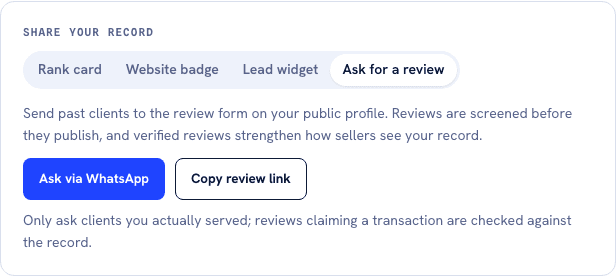
The request surface, which is the honest thing to show while no review has been published yet. The last line is the mechanism: a review that claims a deal is checked against the CEA record, so the review system cannot be used to invent a track record. - 03
Write it
A rating, what stood out, and how you want to be shown. Reviews publish with initials, not your full name.
- 04
It appears with the record
In a verified seller block on the agent's profile, with a completion chip once the agent has logged the completion date.
What it does not do
- The open review door proves an email address, not that the person worked with the agent. That is why the two blocks are labelled separately.
- The completion chip reflects what the agent logged with us, not an independent check against government records.
- Reviews never affect AgentScore, ranking or who receives leads.
- There is no agent reply and no dispute flow yet. If a review is wrong, that matters, and it is on our list.
- Reviews publish with initials, not full names, which is what we promise the reviewer when they write one.
More of what we are building
AgentScore now counts only your own record
The agency Google rating used to be 15 of the 100 points. It is gone. Every point now comes from the agent's own CEA transaction record, and the four remaining dimensions were rescaled to total 100.
The dashboard now starts with what you already are, not a form
Setup is confirmation instead of composition, the worklist reads your real deals, a letter of intent is one tap away, and account admin has its own tab so the surfaces you work on stop asking you for money.
Your dashboard follows the deal now, not our toolbox
One property is one deal. The enquiry, the viewings and the paperwork for the same flat sit together, and the stage moves itself when you finalise a letter of intent or sign a tenancy agreement.